Are Your Teeth Connected to Your Organs? Dental Meridians Explained
By Dr James Goolnik | Clinical Director, Optimal Dental Health | Biological Dentist in London
Can a problem with one tooth affect your heart, liver, kidneys or digestive system? According to traditional dental meridian theories, individual teeth may be connected to specific organs throughout the body. But what does modern science actually tell us about the teeth and organs connection?
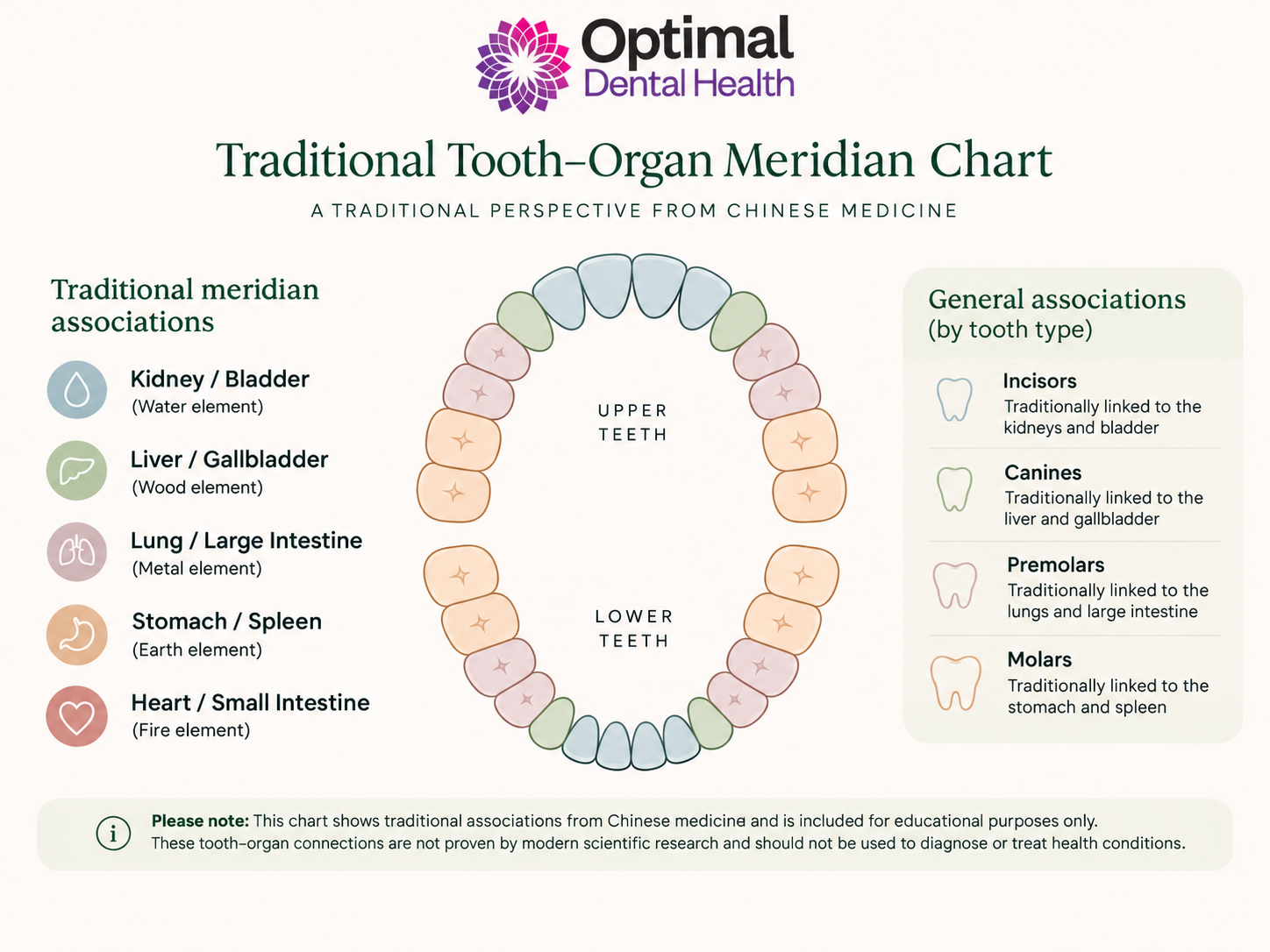
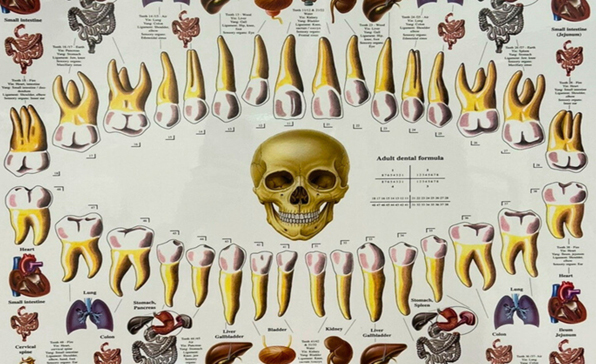
You may have seen a dental meridian chart suggesting that your front teeth are linked to your kidneys, your canine teeth to your liver, or your molars to your stomach.
These charts have become increasingly popular in holistic and biological dentistry, particularly among people interested in the relationship between oral health and overall wellbeing.
However, there is an important distinction between traditional theories and scientifically established connections.
At Optimal Dental Health, our biological dental practice in Marylebone, London, we believe your mouth should never be considered in isolation from the rest of your body. We also believe that patients deserve accurate, evidence-based information when exploring alternative approaches to health.
I have always been fascinated by the relationship between our mouths and the rest of our bodies. In this article, I’ll explore where dental meridian theories originated, what the research actually tells us, and why looking beyond the teeth is such an important part of modern dentistry.
What Is the Teeth and Organs Connection?
The idea of a tooth-organ connection originates primarily from traditional Chinese medicine (TCM), which describes pathways called meridians.
According to this traditional system, vital energy, known as Qi, flows through pathways associated with different organs and physiological functions.
Some practitioners of biological dentistry have adapted these principles into dental meridian charts, suggesting that individual teeth correspond to particular organs or body systems.
For example, certain charts associate the front teeth with the kidneys and bladder, while the molars are associated with the stomach and spleen.
But are these connections scientifically proven?
Currently, there is no convincing clinical evidence that an individual tooth is directly connected to a specific internal organ through a unique meridian pathway.
That does not mean the relationship between oral health and general health is unimportant. In fact, there are well-established connections involving inflammation, infection, immune responses, nerves and the circulation.
The key is understanding which relationships are supported by scientific evidence and which remain traditional theories.
Dental Meridian Chart: Which Teeth Are Linked to Which Organs?
A dental meridian chart, sometimes called a tooth-organ chart, illustrates the proposed relationship between individual teeth and organs.
Although different versions exist, common associations include:
These are traditional associations, not scientifically validated anatomical or diagnostic connections. Charts vary between practitioners and systems.
What does a dental meridian chart actually mean?
Within traditional meridian theory, a problem affecting a particular tooth may be interpreted as reflecting an imbalance elsewhere in the body.
For example, some charts suggest that issues affecting the upper or lower incisors could relate to kidney or bladder function. Others propose that problems involving canine teeth may be associated with the liver or gallbladder.
However, there is no reliable scientific evidence that disease in one of these teeth indicates disease in its traditionally associated organ.
A painful canine tooth does not mean someone has liver disease. Similarly, a kidney condition does not mean that a patient’s incisors will necessarily develop problems. These distinctions are particularly important when patients are considering irreversible dental treatment.
A dental meridian chart should never be used as the sole basis for diagnosing an organ condition, recommending an extraction or deciding whether a root canal-treated tooth should be removed.
What Are Dental Meridians, and Do They Really Exist?
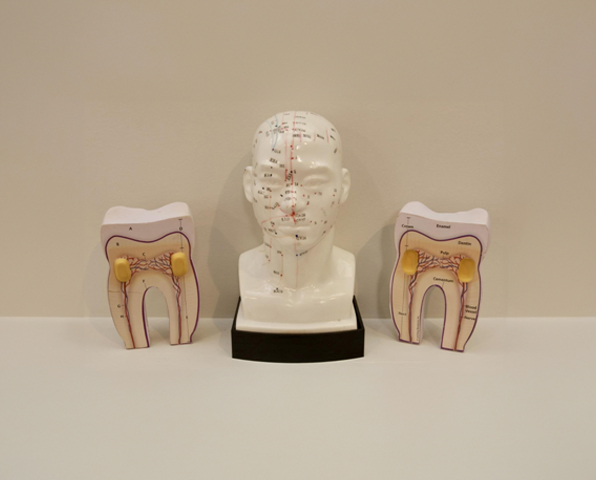
Dental meridians are based on the broader concept of acupuncture meridians used in traditional Chinese medicine.
Unlike nerves, blood vessels and lymphatic vessels, meridians have not been consistently identified as distinct anatomical structures.
However, researchers have investigated whether some effects attributed to meridians might be explained by known physiological mechanisms.
A 2010 scientific review by Professor John Longhurst, published in the Journal of Acupuncture and Meridian Studies, examined several proposed explanations for meridian pathways. [1] [2]
The review explored the potential involvement of sensory nerves, connective tissues and other anatomical structures.
It concluded that the peripheral and central nervous systems provide a more plausible explanation for many acupuncture-related effects than a separate energy-transport system.
This is significant because stimulation of certain areas of the body can influence how the nervous system processes pain and other signals.
However, it does not demonstrate that individual teeth communicate directly with specific internal organs through traditional meridian pathways.
The scientific position: Acupuncture may produce physiological effects, but the existence of tooth-specific organ meridians has not been established.
Acupuncture and Dentistry: What Does the Research Say?
Although research into dental meridian charts remains limited, acupuncture has been studied in relation to several dental conditions.
These include:
- Temporomandibular disorders (TMD) and jaw pain
- Facial pain and muscle tension
- Dental anxiety
- Postoperative discomfort
- Pain management during certain dental procedures
A 2013 study comparing classical acupuncture texts with clinical research into dental disorders highlighted how acupuncture point selection has been investigated in dentistry. [2]
However, evidence for acupuncture as a complementary dental treatment should not be confused with proof of the tooth-organ connection.
Can acupuncture help with TMJ and jaw pain?
Temporomandibular disorders affect the jaw joints, surrounding muscles and associated structures. Symptoms may include jaw pain, clicking, headaches, facial discomfort and difficulty opening the mouth.
A 2017 randomised controlled trial investigated acupuncture in patients with temporomandibular dysfunction. [3]
The researchers compared real acupuncture with a sham procedure and assessed outcomes including pain and mouth opening.
Although some changes were observed, real acupuncture was not significantly more effective than sham acupuncture for the main pain and mouth-opening outcomes.
The study also investigated measurements described within the traditional meridian framework. However, these measurements did not establish the existence of a physiological energy pathway.
This illustrates why controlled clinical trials are important when assessing complementary therapies.
Can acupuncture help with root canal treatment or dental pain?
A 2024 narrative review published in Cureus explored acupuncture as a complementary approach in conservative dentistry and endodontic procedures. [4]
The authors discussed possible applications in pain management, dental anxiety and postoperative discomfort. However, the available evidence remains limited, and further high-quality clinical trials are required.
Acupuncture may be considered as an additional supportive approach for selected patients, but it should not replace appropriate dental diagnosis, local anaesthesia or clinically indicated treatment.
If a tooth has deep decay, an abscess or an infected root canal system, the underlying dental problem must still be addressed. [8]
Electroacupuncture According to Voll: Can It Detect Tooth-Organ Problems?
Another concept sometimes discussed in biological dentistry is Electroacupuncture According to Voll (EAV).
Developed by German physician Dr Reinhold Voll, this method involves measuring electrical resistance at specific points on the skin. [9]
Within the EAV framework, these measurements are interpreted as reflecting the condition of particular organs, tissues or energetic pathways.
The technique has influenced some approaches to complementary medicine and biological dentistry However, skin electrical resistance can vary due to factors including moisture, electrode pressure and contact conditions.
There is currently insufficient reliable clinical evidence that EAV can accurately diagnose internal organ disease or establish whether a particular tooth is affecting another body system.
For this reason, EAV should not replace established medical investigations, clinical dental examinations or appropriate diagnostic imaging.
Are There Real Anatomical Connections Between Your Teeth and the Rest of Your Body?
Yes. Your teeth are connected to the rest of your body through several well-established physiological systems. These include your nervous system, blood circulation, immune responses and inflammatory pathways.
A 2003 paper by Lu and Lu examined the anatomical relevance of acupuncture points in the head and neck, including their possible applications in dental and facial pain. [5]
Understanding these anatomical relationships can help explain why pain and other sensations are sometimes experienced away from their original source.
The trigeminal nerve and referred dental pain
The trigeminal nerve is one of the major cranial nerves responsible for transmitting sensory information from the face, teeth and jaws to the brain.
Because sensory pathways can overlap, pain originating in one area may sometimes be perceived elsewhere.
For example, a patient with an inflamed or infected tooth may experience discomfort that seems to originate from a neighbouring tooth or another part of the jaw.
This phenomenon is known as referred pain. It is a recognised neurological process, but it is different from the proposed energetic relationships illustrated in dental meridian charts.
The Oral-Systemic Connection: What Does Science Actually Prove?
While specific tooth-organ meridian relationships remain unproven, research has identified important connections between oral health and general health.
This is central to our philosophy at Optimal Dental Health.
Rather than viewing teeth as isolated structures, we consider how oral disease, inflammation, medical history, lifestyle and other relevant factors may interact.
1. Gum disease, diabetes and systemic inflammation
One of the strongest examples of the mouth-body connection involves periodontal disease and diabetes. Periodontitis is a chronic inflammatory condition affecting the gums and supporting structures around the teeth.
Research has demonstrated a bidirectional relationship between diabetes and periodontal health. Poorly controlled diabetes can increase the risk and severity of gum disease, while periodontal inflammation may make blood glucose management more difficult.
A 2022 Cochrane systematic review found that treating periodontitis in people with diabetes improved average HbA1c levels by approximately 0.43 percentage points after three to four months, compared with no active treatment or usual care. [6]
This is a clinically relevant finding and provides a much stronger scientific basis for understanding the oral-systemic connection than traditional tooth-organ charts.
2. The oral microbiome and whole-body health
Your mouth contains a complex ecosystem of bacteria, fungi and other microorganisms, collectively known as the oral microbiome.
Many of these microorganisms are part of a healthy oral environment.
However, changes in the microbial community can contribute to dental decay, periodontal disease and other oral health problems.
Researchers are also investigating how oral microorganisms, chronic inflammation and immune responses may be associated with conditions elsewhere in the body.
Not every reported association establishes a direct cause-and-effect relationship. At Optimal Dental Health, we take a prevention-focused approach to the oral microbiome, helping patients understand factors that may influence their oral environment.
Depending on clinical needs, this may include periodontal assessments, plaque analysis, oral hygiene guidance and discussion of relevant microbiome testing.
3. Dental infections and general health
An untreated dental infection can affect more than the tooth itself. Dental abscesses develop when bacterial infection causes a collection of pus in or around a tooth or the surrounding tissues.
In some cases, infection can spread into neighbouring structures and cause serious complications. The NHS advises that a suspected dental abscess requires urgent dental assessment because it will not resolve on its own. [7]
This is a genuine and clinically recognised connection between dental disease and general health. It does not depend on a meridian chart.
4. Sleep, breathing and oral health
The relationship between oral health, sleep and breathing is another important area of holistic dentistry.
Conditions and symptoms such as mouth breathing, dry mouth, bruxism and sleep-disordered breathing may overlap.
For example, persistent dry mouth can increase susceptibility to dental problems, while sleep-related breathing concerns may warrant further assessment.
At Optimal Dental Health, we consider these factors when clinically relevant, rather than focusing exclusively on individual teeth.
This may involve assessing oral health, discussing sleep symptoms and considering appropriate referrals or further investigations. You can find out more about what to expect as a new patient here.
Biological Dentistry in London: Our Approach at Optimal Dental Health
At Optimal Dental Health, our philosophy is straightforward: Your mouth is part of your body, and good dentistry should reflect that.
As a biological and holistic dental practice in Marylebone, London, we aim to understand the wider factors influencing each patient’s oral health.
Our approach combines conventional clinical assessment with a strong emphasis on prevention, minimally invasive dentistry and the oral-systemic connection.
Depending on your individual needs, we may explore:
- Oral microbiome health: Assessing plaque, gum health and factors influencing the balance of oral microorganisms.
- Biological dental hygiene: Supporting periodontal health with a prevention-focused approach.
- Dental materials: Discussing suitable restorative options, including metal-free materials where clinically appropriate.
- Sleep and breathing: Considering relevant airway, breathing and sleep-related concerns.
- Nutrition and lifestyle: Exploring factors that may influence oral disease risk and long-term dental health.
- Clinical investigations: Using dental examinations, radiographs and other appropriate diagnostic tools to support treatment decisions.
We are interested in traditional theories and emerging research, but we do not consider every proposed connection to be scientifically established.
For example, we would not recommend removing a healthy tooth simply because a dental meridian chart associates it with a particular organ.
Nor would we suggest that treating a tooth will cure a liver, kidney or digestive condition.
Our aim is to combine curiosity about the wider relationship between oral and general health with responsible, evidence-informed clinical care.
Frequently Asked Questions About Teeth, Organs and Dental Meridians
Are your teeth really connected to your organs?
Your teeth are connected to the rest of your body through nerves, blood vessels, immune responses and other physiological systems. However, there is no convincing scientific evidence that each tooth has a unique energetic connection to a particular organ, as proposed by dental meridian charts.
Which teeth are connected to the kidneys?
Traditional dental meridian charts commonly associate the incisors, or front teeth, with the kidneys and bladder. This is a traditional theoretical relationship rather than a scientifically proven anatomical connection.
Which teeth are connected to the liver?
In some tooth-organ charts, the canine teeth are associated with the liver and gallbladder. There is currently no reliable evidence that problems with these teeth can diagnose liver disease or that treating them improves liver function.
Can a bad tooth affect your heart?
Dental infections and periodontal disease can have implications for general health. Periodontal disease is associated with cardiovascular disease, although an association does not mean that every dental problem causes heart disease. Certain serious infections may also have systemic consequences.
These relationships are different from the proposed connections in traditional dental meridian theory.
Can an infected tooth make you feel unwell?
Yes. A dental infection can cause pain, swelling, fever and general illness. In some circumstances, infection can spread and become serious.
If you suspect a dental abscess, seek urgent dental advice. Difficulty breathing or swallowing, or significant spreading swelling, requires emergency medical assessment. [7]
Can a root canal affect other organs?
There is no reliable evidence that a properly treated root canal causes disease in a specific internal organ because of a meridian connection.
Root canal treatment is designed to remove infection from inside a tooth and preserve the natural tooth where possible.
As with any dental treatment, appropriate diagnosis, clinical technique and follow-up are important.
Are dental meridian charts scientifically accurate?
Dental meridian charts reflect traditional medical concepts and later interpretations. Their proposed tooth-organ relationships have not been validated through robust clinical research, so they should not be used as diagnostic tools.
Can acupuncture help with dental pain?
Acupuncture has been investigated for jaw pain, facial pain and discomfort associated with dental procedures.
Some research suggests potential benefits, but findings are mixed and the quality of evidence varies. It may be considered as a complementary approach in selected circumstances, rather than a replacement for established dental care.
What is the difference between holistic dentistry and conventional dentistry?
Holistic or biological dentistry generally places particular emphasis on prevention, dental materials, lifestyle and the relationship between oral health and wider wellbeing.
However, these approaches should still be grounded in sound clinical diagnosis, patient safety and the best available scientific evidence.
Final Thoughts: Your Teeth and Your Overall Health
So, are your teeth connected to your organs?
Yes, your oral health is connected to your general health through established biological systems. But the specific tooth-organ relationships shown on dental meridian charts have not been scientifically proven.
Traditional theories can raise interesting questions, particularly when they encourage us to investigate how different parts of the body interact.
However, the most valuable insights come from combining scientific curiosity with rigorous clinical evidence. We already know that oral infections, periodontal inflammation, the oral microbiome and certain systemic conditions can influence dental health and overall wellbeing.
At Optimal Dental Health, we believe understanding these relationships helps us move beyond simply repairing teeth and towards a more comprehensive, prevention-focused approach.
Looking for a Biological Dentist in London?
If you are interested in understanding how your oral health may relate to your wider wellbeing, our team at Optimal Dental Health would be delighted to help.
Located in Marylebone, near Baker Street in Central London, our practice provides comprehensive dental assessments with an emphasis on prevention, minimally invasive treatment and long-term oral health.
Book a dental health assessment with our team and discover a more comprehensive approach to your oral health.
Website: https://www.optimaldentalhealth.co.uk
Address: Optimal Dental Health, 1 Melcombe Street, London NW1
Interested in Learning More About the Oral-Systemic Connection?
From the latest research into the oral microbiome to biological dentistry, sleep, nutrition and longevity, our monthly newsletter explores the science behind better oral and overall health.
Join the Optimal Dental Health Newsletter
About the Author: Dr James Goolnik

Dr James Goolnik: Clinical Director and Principal Dentist, Optimal Dental Health, London
Dr James Goolnik is the Clinical Director and Principal Dentist at Optimal Dental Health, a biological and holistic dental practice in Marylebone, Central London.
With a strong interest in the relationship between oral health and overall wellbeing, Dr Goolnik advocates a prevention-focused, minimally invasive approach to dentistry that considers the wider factors influencing a patient’s health.
He has undertaken training in biological dentistry through the International Academy of Oral Medicine and Toxicology (IAOMT), with particular interests in dental materials, the oral microbiome, periodontal health, nutrition and the oral-systemic connection.
Dr Goolnik is also an author, speaker and dental educator who regularly contributes to discussions about preventive dentistry, oral health and the future of healthcare.
Through his work at Optimal Dental Health, he aims to help patients better understand their oral health and make informed decisions based on clinical evidence, individual needs and long-term wellbeing.
Areas of clinical interest: Biological dentistry, minimally invasive restorative dentistry, preventive oral healthcare, oral microbiome health and the oral-systemic connection.
Practice: Optimal Dental Health, 1 Melcombe Street, Marylebone, London NW1
Website: https://www.optimaldentalhealth.co.uk
Scientific References and Further Reading
[1] Effect of acupuncture for temporomandibular disorders: a randomized clinical trial
https://pubmed.ncbi.nlm.nih.gov/38710498/
[2] Longhurst JC. (2010). Defining Meridians: A Modern Basis of Understanding. Journal of Acupuncture and Meridian Studies, 3(2), 67–74.
https://pubmed.ncbi.nlm.nih.gov/20633518/
[3] Kim SY et al. (2013). A Comparison Study of Acupuncture Points Selection between Classics of Traditional Medicine and Clinical Trials in Dental Disorders. Korean Journal of Acupuncture, 30(4), 201–211.
https://doi.org/10.14406/acu.2013.043
[4] Zotelli VLR et al. (2017). Acupuncture Effect on Pain, Mouth Opening Limitation and on the Energy Meridians in Patients with Temporomandibular Dysfunction: A Randomized Controlled Trial. Journal of Acupuncture and Meridian Studies, 10(5), 351–359.
https://pubmed.ncbi.nlm.nih.gov/29078971/
[5] Priyanka P et al. (2024). Acupuncture as a Complementary Therapy in Conservative and Endodontic Procedures: A Narrative Review. Cureus, 16(12), e75768.
https://pubmed.ncbi.nlm.nih.gov/39822472/
[6] Lu DP, Lu GP. (2003). Anatomical Relevance of Some Acupuncture Points in the Head and Neck Region That Dictate Medical or Dental Application Depending on Depth of Needle Insertion. Acupuncture & Electro-Therapeutics Research, 28(3–4), 145–156.
https://pubmed.ncbi.nlm.nih.gov/14998052/
[7] Simpson TC et al. (2022). Treatment of Periodontitis for Glycaemic Control in People with Diabetes Mellitus. Cochrane Database of Systematic Reviews, CD004714.
https://pubmed.ncbi.nlm.nih.gov/35420698/
[8] NHS. Dental Abscess: Symptoms, Causes and Treatment.
https://www.nhs.uk/conditions/Dental-abscess/
[9] Leonhardt H, Sarkisyanz H, Voll R. (1980)
Fundamentals of Electroacupuncture According to Voll: An Introduction. Medizinisch-Literarische Verlagsgesellschaft, Uelzen, Germany. ISBN: 3-88136-081-6.
Medical disclaimer: This article is provided for educational purposes and does not replace personalised medical or dental advice. Dental meridian theories are discussed as traditional concepts, not scientifically validated diagnostic methods. Treatment decisions should be based on an appropriate clinical assessment and the best available evidence.